

TTFA President lauds U-15 Girls and High-Performance squad for stellar performances
2024-08-10 08:41:41
India’s FAST-DS scheme opens a one-time window until December 31, 2026, allowing eligible taxpayers to disclose certain undisclosed foreign assets and income subject to prescribed conditions and thresholds.
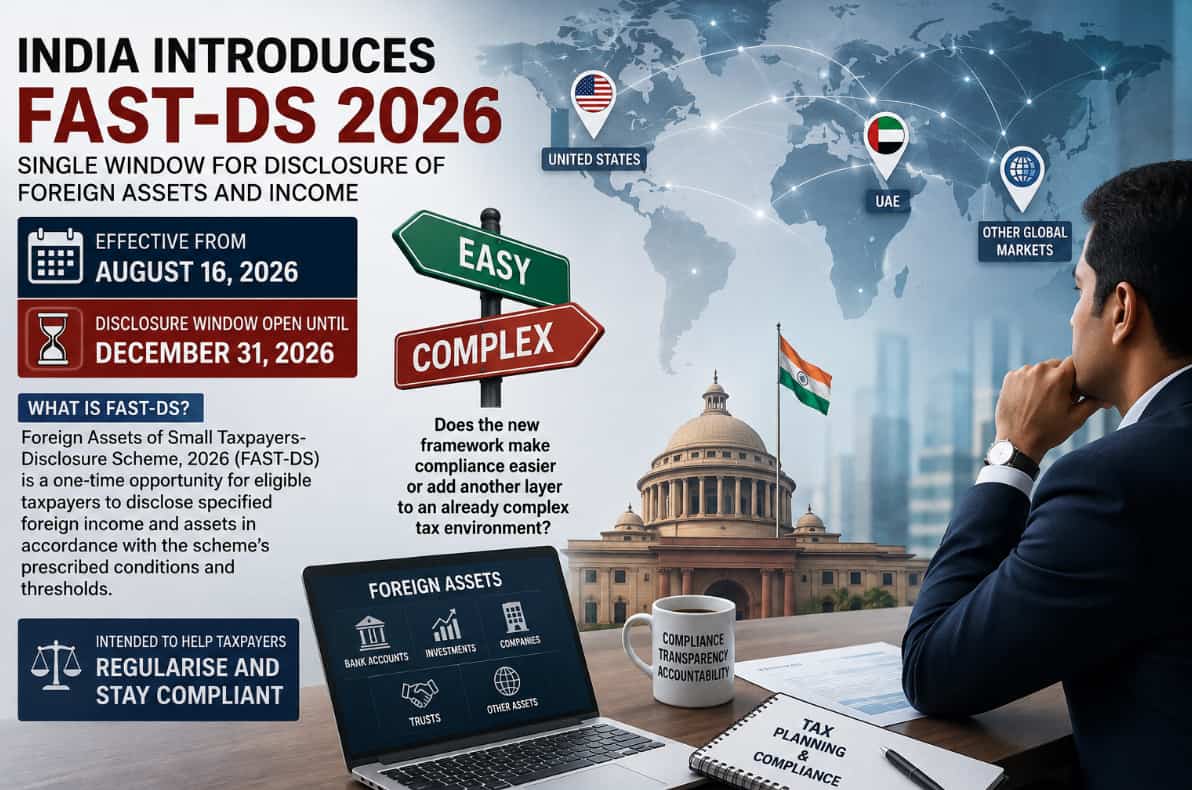
India’s FAST-DS scheme allows eligible taxpayers to disclose specified undisclosed foreign income and assets through a one-time window open until December 31, 2026.
Raising concerns among segments of the Indian diasporas and the business community operating internationally, the Foreign Assets of Small Taxpayers-Disclosure Scheme 2026 (FAST-DS) became effective from August 16, 2026. The single-time window has been opened upto December 31, 2026, by the government of India, permitting entitled taxpayers to reveal their specific foreign income and assets in accordance with the scheme’s prescribed conditions and thresholds.
The scheme is introduced with the intention to direct the taxpayers to regularise the disclosure of foreign income and assets held with them. The initiative is raising larger concerns for the Indian businesspersons with stakes other than India, that does the newly introduced scheme make the compliance easier or does it add a further layer to an already complex tax environment?
In accordance with the Indian entrepreneur, holding business and investments across the country, the problem is not about avoiding taxation. It is about how attainable it is to remain adherent when the personal wealth, business operations, bank accounts, investments and organisations are extended across multiple countries.
A businessperson with established investments in the UAE or alternative global markets, now may have to search beyond the location of an asset and think about how it is owned, when it is gained, whether it has been registered in India, whereas what related documents could be required.
This framework raises an important question, an anonymous businessmen shared with us, if Indian businesses grow to become an global organisation with operations spread across nations, should the nation’s compliance framework progress to make that global entrepreneurship straightforward to manage the business or simply record the growing burden. Although, the FAST-DS scheme is not a continuous regularisation system for every foreign asset held by every taxpayer.
The scheme comprises different categories with stated aggregate thresholds. System’s category 1 provision’s, qualifying unrevealed foreign assets or income, subject to a Rs 1 crore (Approx USD 105,000) aggregate threshold, whereas category 2 addresses specific qualifying foreign assets up to a threshold of Rs 5 crore (Approx USD 523,000) aggregate, in accordance with the prescribed conditions.
For internationally active businesspersons, the problem becomes extensively significant because when foreign assets are spread across the nation such as the UAE. The US citizens are obliged to report their foreign assets. In which the systems such as (FATCA) Foreign Account Tax Compliance Act and (FBAR) Foreign Bank Account Report, enforce additional obligations to which citizens need to comply strictly.
Whereas, the UAE also operates FATCA and the Common Reporting Standard (CRS) system, making the global financial activity commonly subject to disclosing the information and exchange between international territories. Simply indicating that Dubai can no longer be preferred as an overseas destination, within which financial assets remain outside the international reporting system.
This raises a wider question among the Indian businesspersons, whether the system is fair or fatally complex, to foster and develop the business further. The concern demands a business suitable alternative among the diaspora compatible with a question that, if remaining an Indian tax resident is a viable option for businesspeople.
However, the businessperson needs not only to attain another passport or citizenship, alongside the requirement of changing his tax residence and meet the regulations applicable.


